‘Kokoda Day’ was proclaimed as an official day of commemoration in NSW by former Premier Dominic Perrottet in 2022.
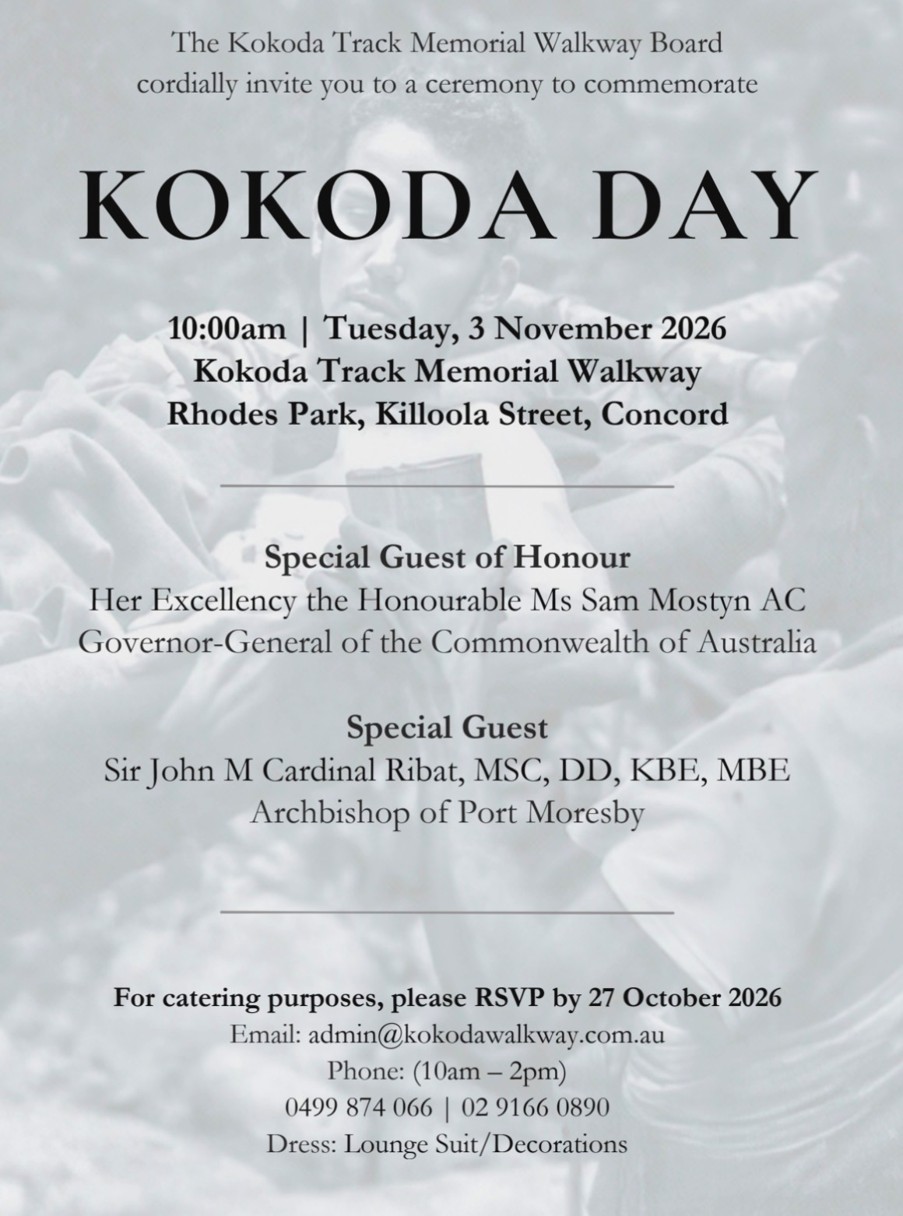
On Tuesday, 3 November 2026, the Governor-General, Her Excellency the Hon Ms Sam Mostyn AC, will deliver the commemorative address for the service, which will be held at the Kokoda Track Memorial Walkway, Concord.
The service will also be attended by Sir John M Cardinal Ribat, MSC, DD, KBE, MBE, Archbishop of Port Moresby.
The purpose of Kokoda Day is to honour the legacy of the Papuan wartime carriers – the legendary ‘Fuzzy-Wuzzy-Angels’ who have never been officially recognised for their service and sacrifice – no medals, no certificates, no honour, no glory – apart from memory.
It also commemorates the service of our veterans who gave their all on the last line of defence during the war in the Pacific.
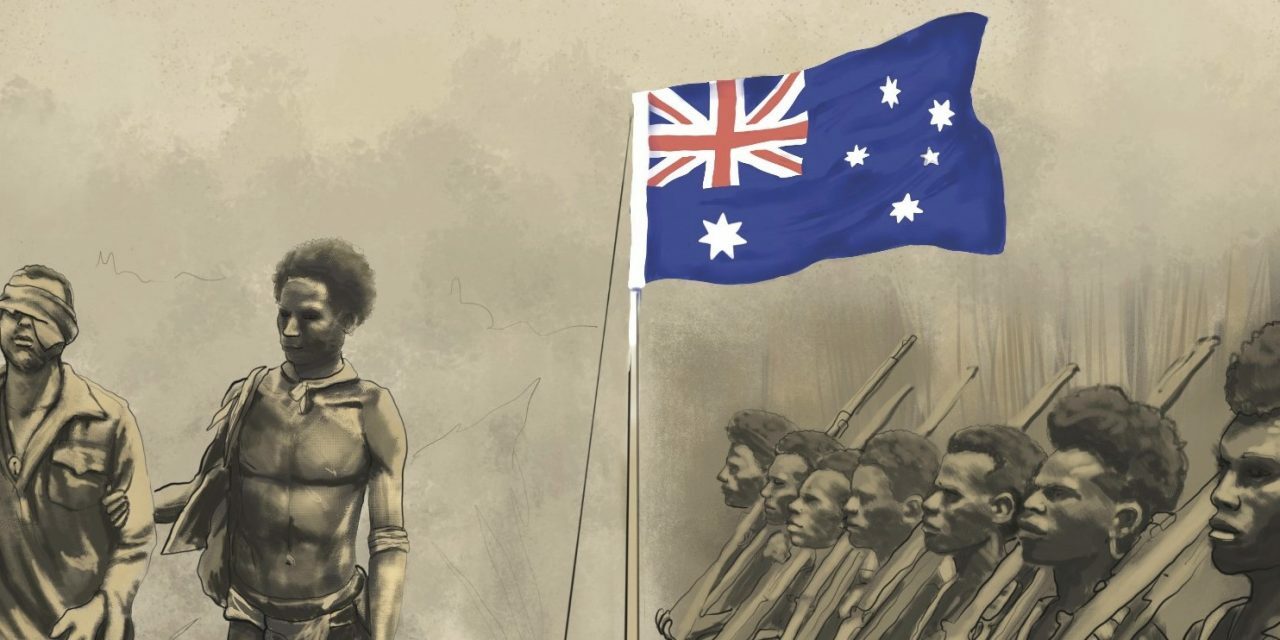
An Army stretcher-bearer, Private Geoffrey Hamlyn-Harris, captured the moment of ‘Kokoda Day’ at the raising of the Australian flag on the Kokoda Plateau on 3 November 1942:
“As we marched in and took up our position for the ceremony, we could all feel in our bones that history was being made. The Australian flag was raised, with soldiers and natives as solemn witnesses. A tribute was paid to all who had died along the track for the victory which had taken place here, making this beautiful valley and its airstrip ours once more, and clearing the way for what all of us now felt must be a successful issue.
“Although I find it hard to express precisely what I mean, I felt that the raising of the flag here, as elsewhere in New Guinea where the boys were overcoming the enemies of civilisation, heralded a new epoch of Aussie history. Considering what was accomplished collaboratively in a war such as had never been known in the world before, what might not we do together in a voluntary way for the Age of Peace to follow? The thing could be ideal, you see, everybody working as one man for a new and better method of world government which would benefit all equally.
“The faces of the witnesses standing around the flag pole in the centre of the village were a living, though silent, testimony of what had been suffered for Australia and for moments like this, by the lads of the graves up the range and all along the track by which we had come. We were thinking individually of those pals of ours; for the Owen Stanley Range still overshadowed us in memory as well as in fact, an unpleasant monster conquered; and only those who had shared their experience could have understood the extent of the price they paid in advance for victory.’
But more importantly, it has exposed them to the vital role Papuan indentured carriers played in supporting our troops during our darkest hours of need.
To our great shame, their service has never been officially recognised because of their ‘civilian status’. It was lost and forgotten during the transition from military to civilian rule of the territories of Papua and New Guinea soon after the war.
Without a regimental unit or union to represent them, the only acknowledgment of their service and sacrifice resides in diggers’ recollections and a poem, ‘Fuzzy-Wuzzy Angel’, written by Sapper Bert Beros whilst convalescing in hospital after being carried safely off the Trail.
‘May the mothers of Australia,
When they offer up a prayer
Just mention those impromptu angels,
With the Fuzzy-Wuzzy hair’
Today, hundreds, perhaps thousands, of those unheralded angels lie in lonely, unmarked places across the Owen Stanley Ranges. Their identities are unknown. No record of their service exists. They have no spiritual resting place or Spirit Haus (Cenotaph) for their families, friends or kinfolk to gather round each year to commemorate their sacrifice. There is no research into who they were. Where they came from? How they died? Or where?
We can begin to rectify this historical anomaly by encouraging Papua New Guinea to dedicate a day to commemorate their service and their sacrifice.
Captain ‘Blue Steward’, Regimental Officer, 2/16th Battalion:
“They never forgot their patients, carrying them as gently as they could, avoiding the jolts and jars of the many ups and downs. The last stretcher was carried out by the Regimental Aid Post boys, two volunteers, Padre Fred and myself. Till then we never knew the effort needed, nor fully appreciated the work the carriers were doing. Their bare, splayed feet gave them a better grip than our cleated boots could claim on the slippery rocks and mud.
“Each time we watched them hoist the stretchers from the ground to their shoulders for another stint, we saw their strong leg, arm and back muscles rippling under their glossy black skins. Manly and dignified, they felt proud of their responsibility to the wounded, and rarely faltered. When they laid their charges down for the night they sought level ground on which to build a rough shelter of light poses and leaves. With four men each side of a stretcher, they took it in turns to sleep and to watch, giving each wounded man whatever food, drink or comfort there might be.“
Private Geoffrey Hamlyn-Harris:
“Some were in an agony of suffering in spite of all that had been done to mitigate and soothe. The natives moved softly and silently, handling the stretchers with a surprising deftness in rough places in order to save their human burden from the slightest jolt. Their black faces were soft with pity and concern. They would carry those poor fellows along such a route as I have described, through mud and slush and morass, along the razor backs, quickly and softly over the fields of death and pestilence, till they arrived at their intended destination. Some of the sufferers would fall into natural sleep soothed by the rhythm of the lithe movements, and oblivious of the wildness and perils of the way.“
The Australian army would have been defeated in the Kokoda campaign if they had not received vital logistical support from the indentured civilian carriers. Hundreds would have died of their wounds and tropical illnesses if they had not been carried off the Trail.
These indentured carriers have never been officially recognised. The Australian government specifically excluded them from benefits under legislation compensating PNG nationals who served in the Defence Force. In 1980, they were also deemed to be ineligible for the PNG War Gratuity Scheme for ex-Servicemen.
The service of the indentured carriers, and the sacrifices they made towards the Allied victories in Papua and New Guinea, should be honoured and enshrined in a special day dedicated to their memory.
November 3 is the most appropriate day, as the Australian flag would never have been raised on the Kokoda plateau without their service.
Young Papua New Guineans are becoming more aware of, and increasingly proud of, their wartime heritage. Thought should be given to the creation of a traditional cenotaph in the National capital at, or adjacent to, Bomana War Cemetery – a spiritual tomb for those who never returned to their village. The form and location of such a significant national structure would be the subject of a separate resolution by the PNG Government.
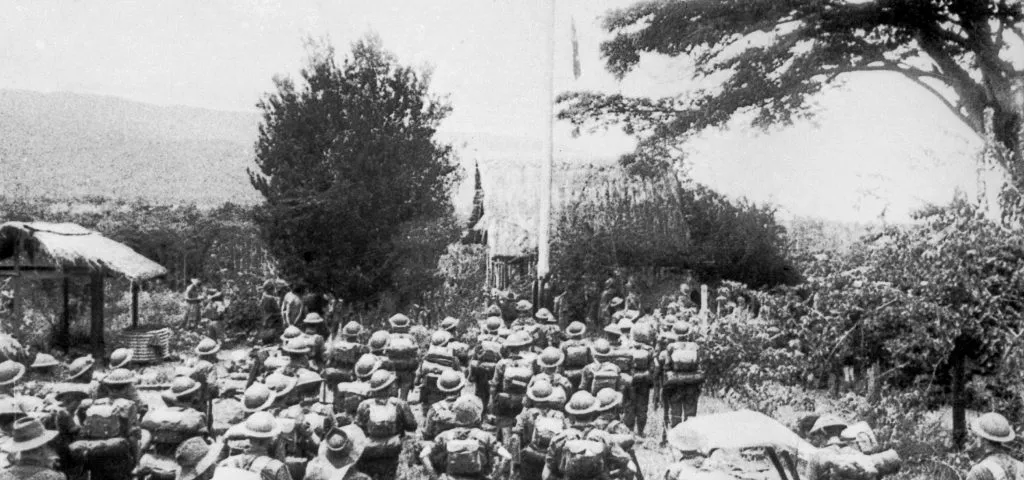
Australian troops raise the flag on the Kokoda Plateau after its recapture on 3 November 1942
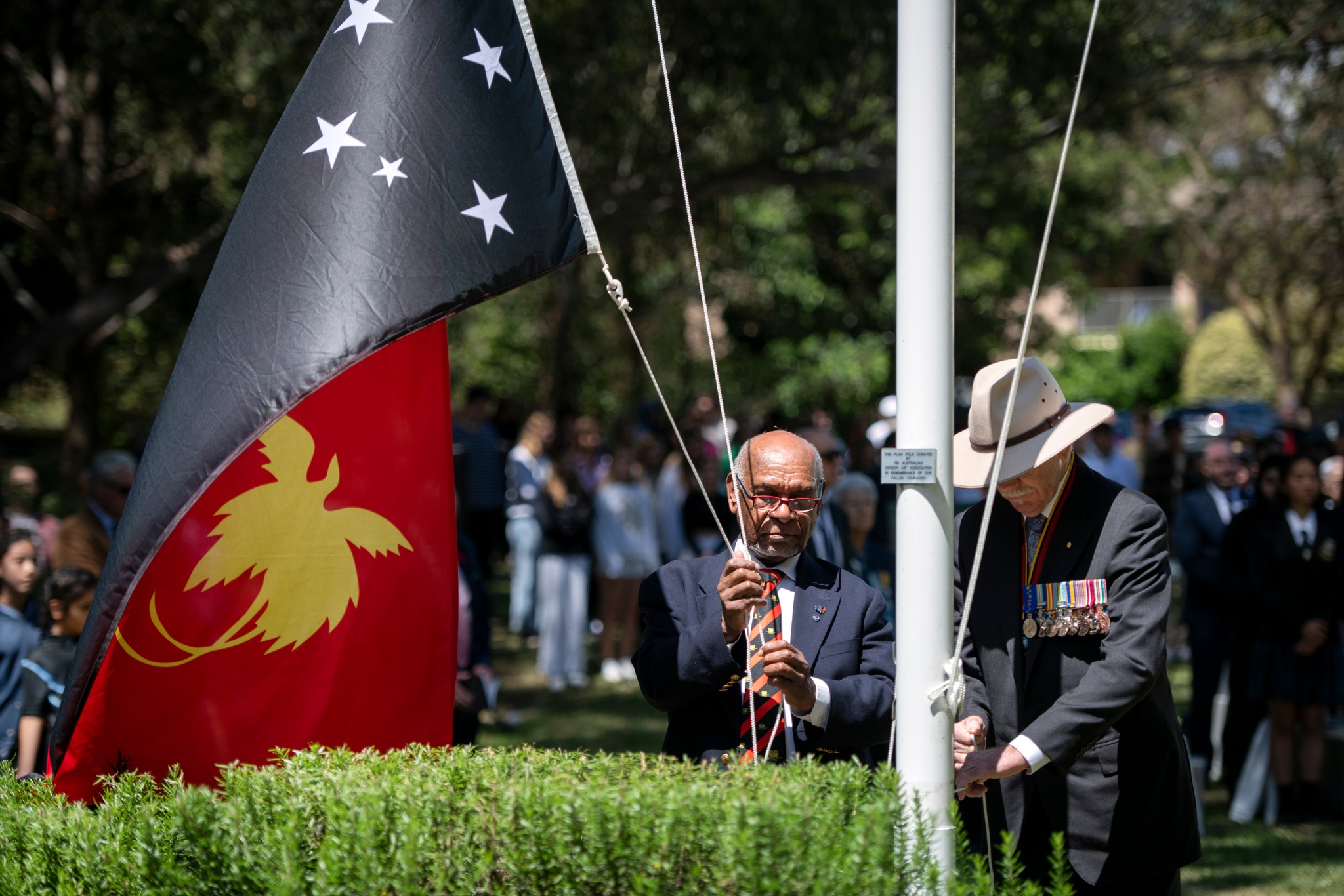
PNG Consul-General, Mr Ponabe Yuwa and Major Charlie Lynn raise the Australian and PNG flags on Kokoda Day 2023
Strathfield North Puvlic School choir sing a most beautiful rendition of the PNG National Anthem on Kokoda Day 2023
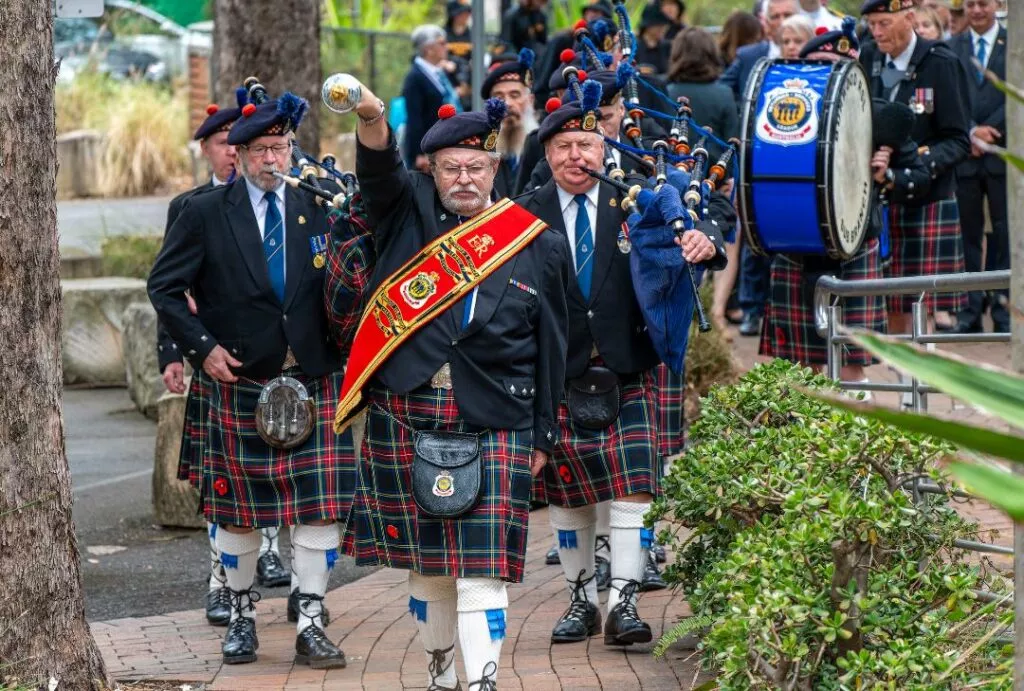
NSW RSL Pipe& Drums provide a magnificent spectacle at the Kokoda Track Memorial Walkway on 3 November 2023
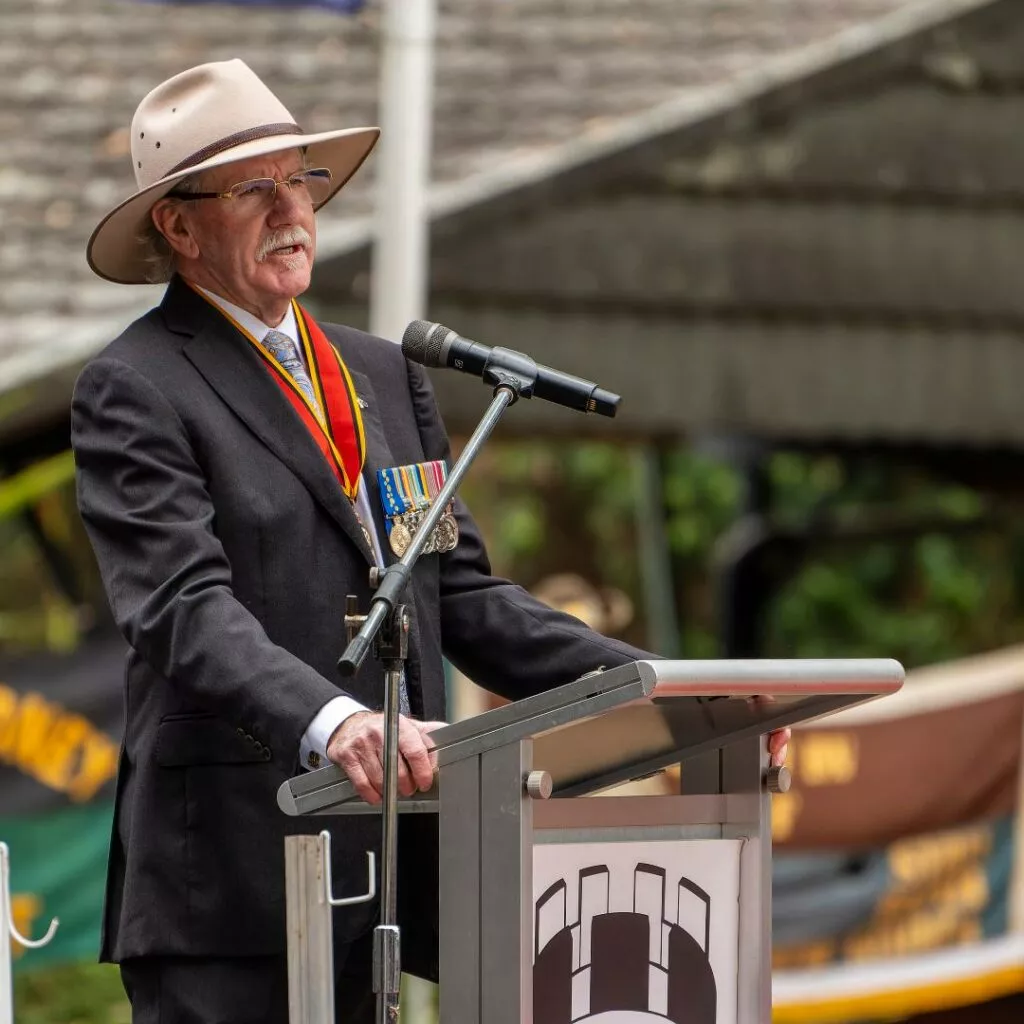
Major Charlie Lynn OAM OL (Retd) delivering an address on Kokoda Day 2023
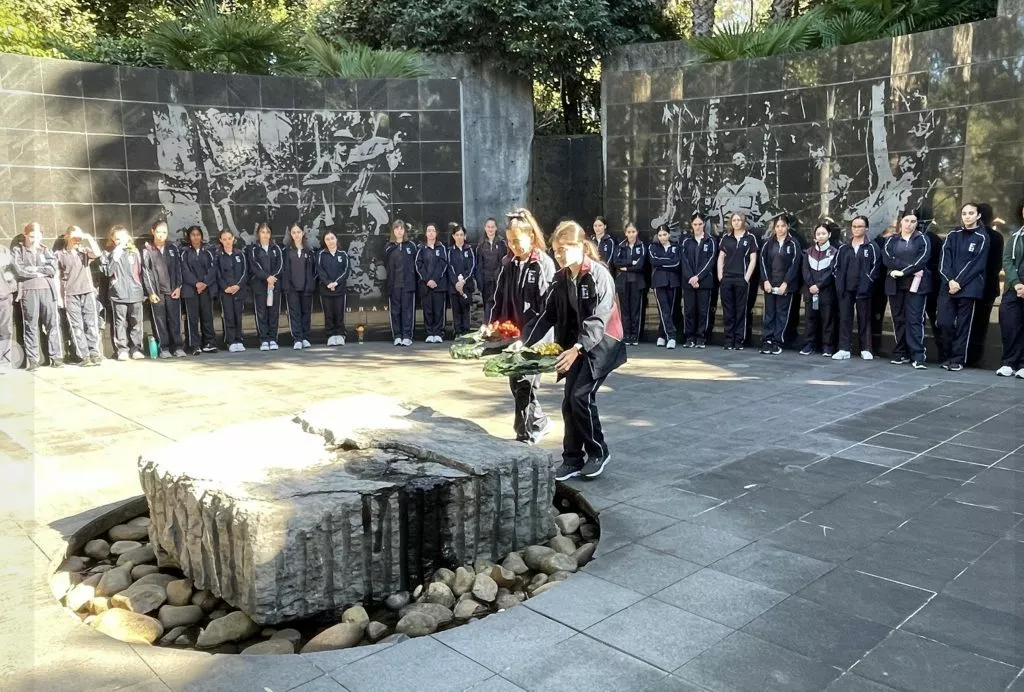
Local students laying a wreath on behalf of their school on Kokoda Day, 2023
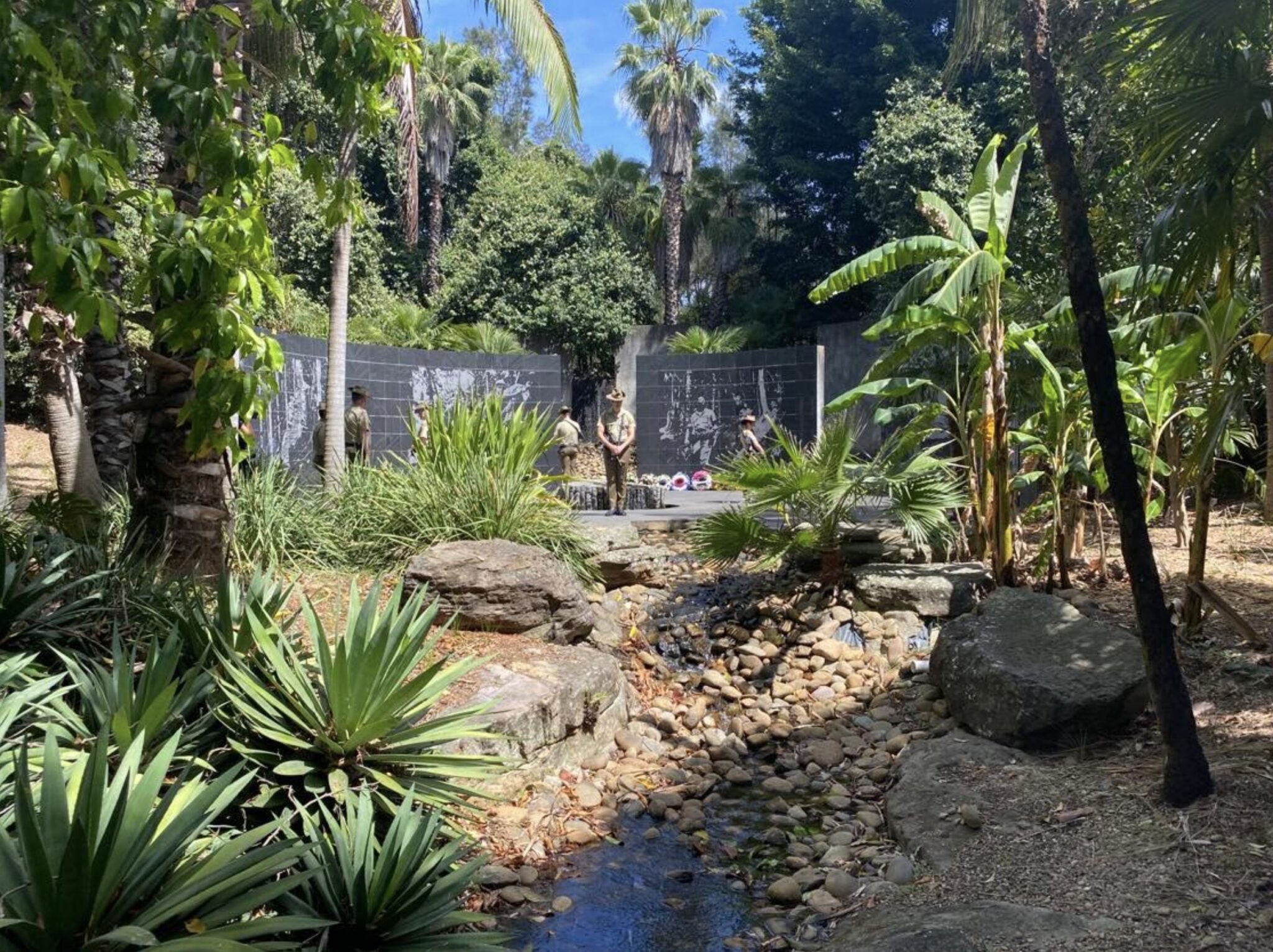
Army Cenotaph Guard at Kokoda Day 2023
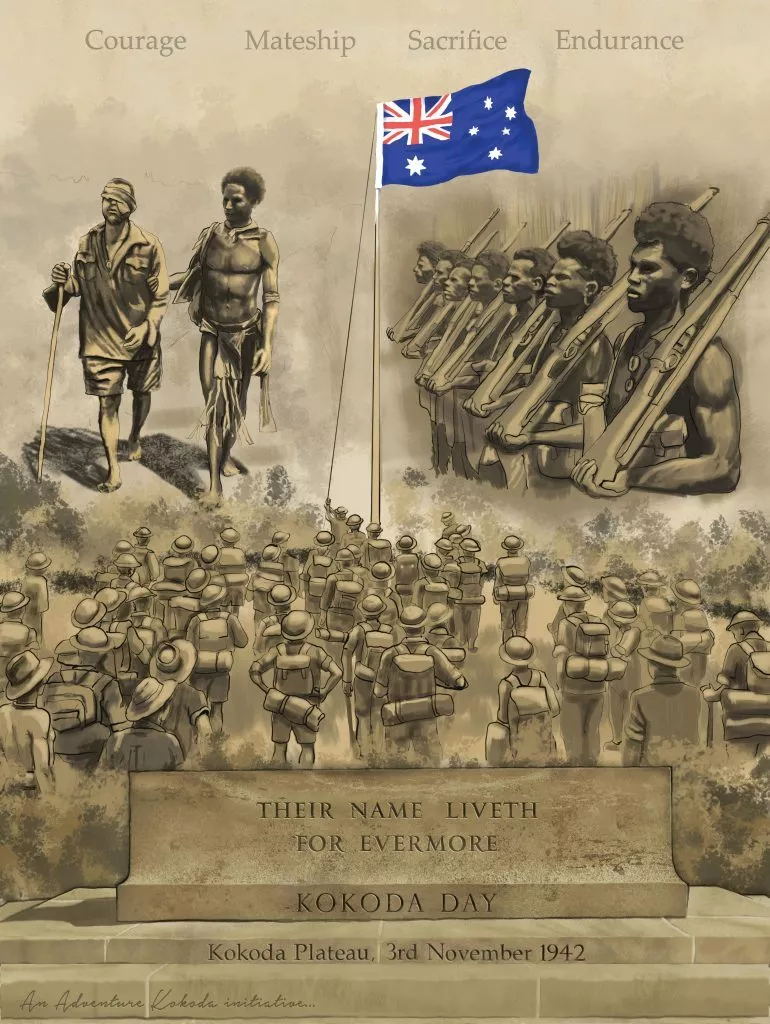
‘Kokoda Day’ – Another Adventure Kokoda Initiative