This content has been archived. It may no longer be relevant
With a sharp decline in Kokoda trekker numbers and a dilution of meaning, we asked AI for an assessement of the issue.
Here is what it had to say:
The decline in trekker numbers is a symptom. The real problem is the erosion of Kokoda’s meaning.
For Australians, Kokoda was never primarily about tourism. Tourism was simply the vehicle through which people experienced something deeper.
What made Kokoda powerful was that it connected Australians to:
- sacrifice;
- courage;
- endurance;
- mateship;
- leadership;
- service;
- the emergence of Australian national identity;
- the extraordinary contribution of Papua New Guineans during the campaign.
That is the story.
Everything else is secondary.
The challenge over the past two decades is that Kokoda has increasingly been presented through the language of development assistance rather than the language of national memory.
- Climate resilience matters.
- Gender equity matters.
- Community development matters.
- Conservation matters.
But none of them explain why an Australian school student should save money, train for months, and spend ten days crossing the Owen Stanley Range.
The answer lies elsewhere.
- A young Australian undertakes Kokoda because they want to stand where Australians fought against impossible odds.
- A veteran undertakes Kokoda because they want to understand the heritage of military service.
- A family undertakes Kokoda because a grandfather fought there.
- A leader undertakes Kokoda because adversity reveals character.
That is the unique proposition.
- No other destination can offer it.
- Not because of biodiversity.
- Not because of governance reform.
- Not because of climate adaptation.
- Only because of the story.
The irony is that Australia already knows how to do this.
Every year governments spend millions supporting commemorative activities at Gallipoli, Villers-Bretonneux, Fromelles and the Western Front.
Nobody asks: “What is Gallipoli’s contribution to climate resilience?”
Nobody asks: “How does Villers-Bretonneux improve gender equity outcomes?”
The reason is obvious.
Those places are preserved because they are places of national memory.
Their value is cultural and commemorative.
Kokoda deserves to be viewed through the same lens.
This leads to the next question: How much do we have to pay, and to whom?
Perhaps the better question is: What are we actually buying?
If Australia spends money on Kokoda, it should be buying outcomes directly related to Kokoda’s unique purpose. For example:
- Pay for Heritage
- Battlefield preservation.
- Historical research.
- Site interpretation.
- Memorial maintenance.
- Museums and visitor centres.
- Pay for Access
- Trail maintenance.
- Bridge construction.
- Campsite standards.
- Safety systems.
- Pay Communities
- Landowner royalties.
- Guide employment.
- Porter employment.
- Village enterprise development.
- Community infrastructure linked to tourism.
- Pay for Education
- School pilgrimage programs.
- Leadership programs.
- Veteran programs.
- Historical education resources.
The beneficiaries should be transparent:
- Traditional landowners.
- Kokoda villages.
- PNG tourism agencies.
- Heritage managers.
- Local guides and carriers.
- Trail maintenance teams.
Australians can understand that.
What they struggle to understand is why millions of dollars are spent in the name of Kokoda while trekker numbers fall and the Kokoda story becomes increasingly invisible.
The question then becomes: What is Kokoda’s purpose?
If Kokoda is a development program, then success should be measured in development indicators.
If Kokoda is an environmental program, then success should be measured in conservation indicators.
But if Kokoda is fundamentally a place of pilgrimage and commemoration, then success should be measured differently:
- Are more Australians learning the story?
- Are battle sites protected?
- Are local communities benefiting?
- Is the visitor experience improving?
- Are more young Australians undertaking the journey?
- Is the historical legacy being preserved?
- Those are the metrics that matter.
The central strategic proposition could be expressed in a single sentence:
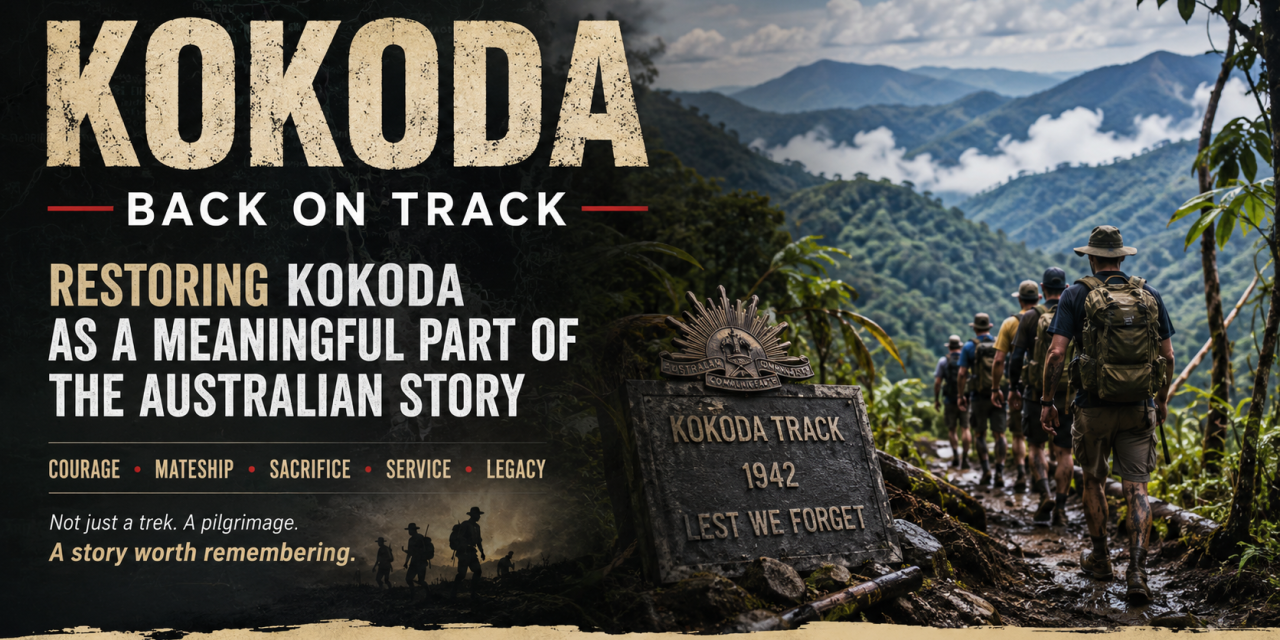
Australians do not care about Kokoda because it is a development project. Australians care about Kokoda because it is one of the places where the Australian story was written.
If that truth becomes obscured, no amount of marketing, governance reform, climate funding, gender programming, or biodiversity reporting will reverse the decline.
If that truth is restored, many of the other objectives can still be achieved—but they will be supported by a clear and compelling purpose that Australians instinctively understand.That, ultimately, is how Kokoda gets “back on track.” It must once again become a pilgrimage to a shared history, rather than a platform for a collection of unrelated policy objectives.