

Australia is failing to honour the Kokoda Track legacy by buckling to a “woke” gender and climate change focus in Papua New Guinea that ignores the history and basic needs along the trail ?including sanitation, according to an expert across the battlefield.
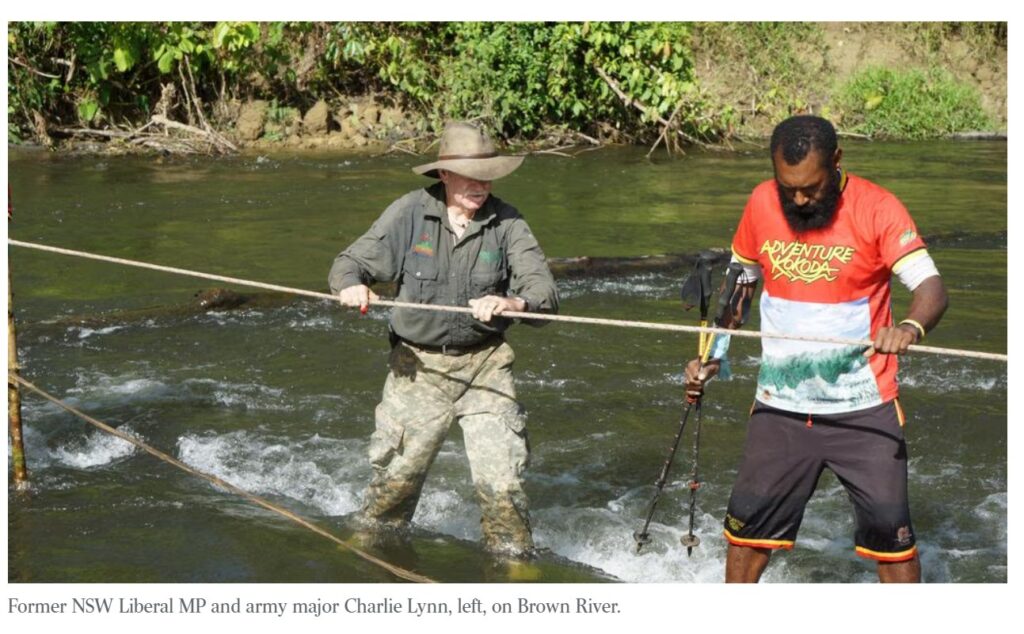
Former army major Charlie Lynn has walked the trail more than 100 times and has warned the Australian government is focusing on a “woke” agenda amid a collapse in tourist numbers and a failure to provide basic amenities in some areas.
Mr Lynn, a former NSW Liberal MP, said both sides of politics had failed to grasp the needs of the trail and to encourage the telling of the military history. He said there was deeply limited information on some key battles, and bureaucrats misunderstood life among the villagers, many of whom are practising and disciplined Seventh Day Adventists who he said did not need to be lectured on issues such as gender.
He said the Australian focus in PNG had been at the expense of a valuable revenue stream for locals and that a commonsense, pragmatic strategy was needed to deal with the area. “You can’t book a campsite anywhere along the trail,’’ he said. “It’s the chaos theory of management.’’
He said the diplomatic emphasis on gender was irrelevant at Kokoda because of the ordered religious lives of the villagers. “There is no need for us to impose our social values on them. They have got it worked out,’’ he said.
Mr Lynn’s concerns were echoed by Victorian opposition veterans affairs spokesman Tim Bull, who said there had been a failure from both sides of politics to provide enough battle history along the entire 96km track.
While there was information at Kokoda and Isurava, “they’ve only scratched the surface’’ elsewhere, he said.
Mr Lynn added that more sites needed to be properly honoured with detailed information.
“I reckon it’s a disgrace,’’ he said, adding there was a “woke” funding criteria for projects.
The Department of Foreign Affairs and Trade was approached for comment.
The PNG-based Kokoda Track Authority oversees tourism on the trail. The Australian-based Kokoda Track Foundation, a non-government organisation, has argued for the need to deal with gender issues in PNG.
“PNG is a nation as diverse as its landscapes, where cultures and traditions are cornerstone to people’s identities,’’ it has argued.
“However, amid this cultural diversity lies the complexity of gender inequalities and barriers to inclusion that shape the lives of its people, particularly vulnerable populations including women and girls. PNG grapples with entrenched challenges related to women’s status, gender norms, and cultural barriers.
Mr Lynn, who ran treks in PNG for decades, estimated the number of people trekking in PNG along the Kokoda Track had fallen by more than 50 per cent between 2008 and 2025. There were 5621 trekkers in 2008. He said a misguided strategy on the ground and a lack of endeavour in Australia had led to the collapse in trekking numbers and the failure to concentrate on the history of the Kokoda campaign.
The Kokoda campaign in 1942 during World War II was where Australian forces stopped the Japanese advance on Port Moresby. The Kokoda Track was the only viable route from the north to the south of the island and as such was crucial to the Japanese march towards Australia, Darwin having been bombed that year.
Battle casualties across the broader campaign including Kokoda, Milne Bay and Buna-Gona were high, killing more than 2000 Australian soldiers and wounding 3600 others. More than 13,000 Japanese died.
Kokoda became a by-word for military suffering due to the tough, mountainous conditions and tropical heat.
Mr Lynn said the villagers along the Kokoda Track were not receiving the benefits of a well-run system. “I’ve got a fair idea what the villagers want,’’ he said. “They’re worse off than they’ve ever been. They are managing it as an environmental park rather than a tourism enterprise.’’
Mr Bull, who has trekked ?Kokoda five times and is about to do it a sixth, said the focus on ?climate change and gender for funding projects meant the spotlight was not on the history that made the route famous for Australians.

