
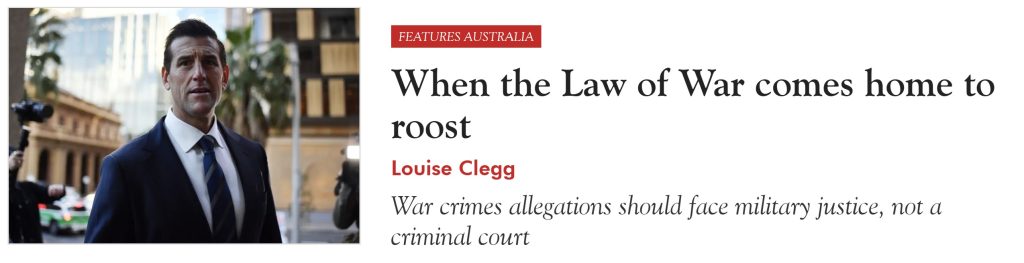
Ben Roberts-Smith VC was arrested this week after a long-running investigation into alleged war crimes in Afghanistan. He was not just arrested – he was subjected to a very public, American-style ‘perp walk’, on the apron of an airport, in full view not just of the public but also of his teenage daughters. None of this happened by accident. It presages the more disturbing aspects of a process that has slipped its moorings.
The serious allegations have already been exposed in a civil trial and the images are confronting. But while the country settles into familiar camps for or against the man, it is worth pausing to examine the legal architecture under which this moment has arrived. What will now unfold before twelve civilian jurors did not begin in Afghanistan. It began in Canberra in 2002.
That year, Australia enacted sweeping amendments to the Commonwealth Criminal Code, inserting Division 268. Its purpose was clear: to create offences of international concern and ensure Australia’s jurisdiction was ‘complementary’ to that of the International Criminal Court. Under the Howard government, parliament ensured that if war crimes were committed, Australia could prosecute them itself, rather than leaving the matter to The Hague. What was once the work of courts martial became proceedings in the ordinary criminal courts.
The principle of complementarity does not require what Australia did. It requires only that a state genuinely investigate and, where appropriate, prosecute. It does not prescribe civilian courts, jury trials, or wholesale incorporation of every Rome Statute offence into domestic law.
On one level, this ‘domestication’ of international law was understandable. The late-1990s and early-2000s marked a high-water point of ‘end of history’ internationalism. The Rome Statute had been adopted. The horrors of the Balkans and Rwanda were fresh. There was a conviction that the ‘worst crimes’ should never go unpunished. War crimes damage not only victims but national reputation and military morale. A willingness to investigate one’s own was seen as what civilised nations do to maintain integrity in the theatre of war.
Yet Australia did not just join the project; it embraced it in full. Division 268 is not selective. It is a near-complete codification of international criminal law: genocide, crimes against humanity, and war crimes, each broken into multiple offences, from murder and inhumane treatment to unlawful confinement and destruction of property not justified by military necessity. The gravest offences carry life imprisonment; even lesser ones attract penalties of 25 or 17 years.
Here the first tension arises. The political justification spoke in the language of exceptional evil. But once translated into legislation, ‘war crimes’ became a detailed catalogue of conduct, not all of the same moral order as the crimes that animated the project.
Australia imported the project wholesale, placing itself at the more expansive end of comparable democracies.
The United States never ratified the Rome Statute. Its War Crimes Act is narrower, confined to grave breaches, with a clear concern for sovereignty to protect US personnel. The UK implemented the Statute but relied heavily on military processes; investigations into Iraq abuses were curtailed after years of controversy. A 2021 law makes prosecutions for overseas conduct more than five years old exceptional, requiring Attorney-General approval.
Australia, by contrast, continued at full throttle, albeit with Attorney-General consent still required for prosecutions.
What makes the Australian position distinctive is the overlay of our constitutional arrangements. Under section 80, trials on indictment for Commonwealth offences must be by jury. These offences, drawn from international treaties and applied to conduct in distant war zones, once in the Criminal Code, must be determined by twelve ordinary citizens in a civilian courtroom. In the United States, such allegations would be prosecuted by court martial.
This matters. The criminal law assumes access to crime scenes, forensic evidence, and witnesses who can be tested contemporaneously. Yet even the Office of the Special Investigator has acknowledged the realities: no access to Afghanistan, no post-mortems, no ballistic evidence, often little more than photographs and recollections.
None of this is to suggest serious allegations should not be investigated, or grave wrongdoing excused. But the system now deployed was not designed for these circumstances. It reflects a fusion of two impulses: the late-20th-century drive to universalise international (including war) criminal law, and the older constitutional commitment to trial by jury in ordinary courts.
But the political context has shifted. These laws were enacted in an era of confidence in international institutions, before the concept of lawfare: the use of legal processes to pursue political ends, including recently by the International Criminal Court itself. Two decades on, that confidence has eroded. The strategic environment is uncertain, the global and local economic outlook deteriorating, and public patience for years-long processes – this one costing hundreds of millions – is fraying. It is not surprising many Australians feel this process is not on a firm footing.
I make no defence of Ben Roberts-Smith. But there are real questions about delay and cost, the institutional fit of a modern jury trial for wartime conduct, and whether parliament in 2002 fully appreciated the divisions it might create in a more polarised world when it copy and pasted the most expansive vision of international criminal justice into domestic law.
The politicisation and weaponisation by political actors and media of our most decorated living soldier through this very public process will be devastating to the morale of our defence forces – and to recruitment and retention – at the worst possible time. We are embarked on yet another legal circus that will be used to rip the country apart. Long story short, this process should be playing out in a system of military justice, not the ordinary criminal courts.