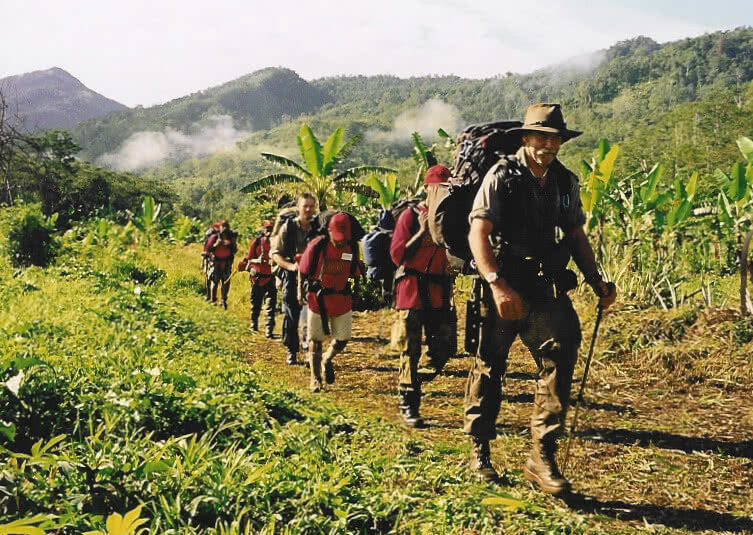

‘You can’t let them kill my guide just because they think he’s a sorceror!‘ I bellowed to the police at the end of my 37th expedition across the Kokoda Trail last year.
A couple of recruits I had engaged had dediced that one of my older guides, from a neighbouring village, was a sorcerer. So they felt obligated to kill him. The impending execution was no apparent to my Western mind. We had trekked together, sung traditional songs of an evening together, and they had worked assiduously to ensure every one of my band of trekkers compled their journey safely.
As we sat down to dinner in Port Moresbym we refkected on their selfless devotion to us and agreed they were proud sons of the Fuzzy-Wuzzy Angels. But they had unfinished business in their own tribe, and by the time we finished our meal the alleged sorcerer was dead.
Incredibly there was no public outcry. Just a plea from his village near Kokoda for the return of his body. This was arranged and I can only surmise that the ‘sorcerers’ village has since dispatched somebody to fulfil the payback obligations their culture demand.
After 15 years of roaming Papua New Guinea – climbing mountains, exploring burial caves, attending Highland ‘sing-sings’, leading numerous expeditions across Kokoda, and meeting politicians at the national, provincial and local government levels I thought I was beginning to understand this land of a thousand cultures.
But Papua New Guinea is the ‘land of the unexpected’ and as soon as you think you are beginning to understand, the unexpected surely happens.
Last week’s heavy-handed directive to banning PNG Ministerial visits and todays Foreign Affairs Traveller’s Warning Advisory reflects a growing frustration with our closest neighbour and a lack of understanding of the intangible ‘Melanesian way’.
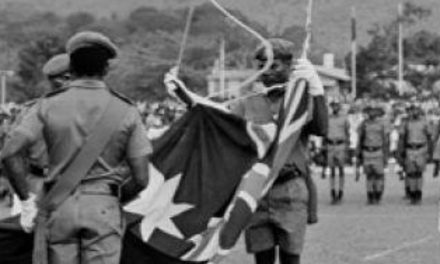
The seeds of discontent can be traced to our hurried exit from PNG in response to a global movement against colonization in the 1970s. It is often argued that independence came too early for a nation of a thousand tribes each with its own distinctive language and complex social customs involving sorcery, cannibalism and payback.
Up till independence in 1975 Australia had managed her colony in a caring and responsible fashion. Under Governor Sir Hubert Murray’s long reign native culture and the environment were protected against ‘the indecencies of modern man’.
Politicians from both sides of the political divide, Gough Whitlam and Sir Paul Hasluck, were highly regarded because of their compassion for the local people and their shared vision for the fledgling nation.
In modern parlance, Australia had embedded representatives in the new nation with ‘kiaps’, or Patrol Officers under their colonial regime. Many took out PNG citizenship, married indigenous women and raised families. These former Kiaps were a valuable resource as they provided us with a good insight into the complexities of the Melanesian mind. Sadly, they are now approaching retirement and their corporate knowledge will soon be lost to Australia.
Papua New Guineans also gained insight into our western way of thinking as many attended school and university in Australia. During their studies they established friendships with fellow students, joined football teams, attended church camps and were active in local communities.
PNG now has its own university and the student flow to Australia has been reduced to a trickle.
These factors have resulted in a widening empathic gap. We no longer have people living in PNG villages and they no longer come to Australia.
This gap is reflected in our racist and discriminatory attitudes towards seasonal work opportunities for PNG citizens and a paternalistic approach to the management of our aid budget. We are not seen as ‘cousins’ in the Pacific but as an impatient and intolerant ‘big brother’. Our continual reference to the country as a ‘failed state’ and our veiled threats of intervention do little to change this perception. As a result, they will stick it to us whenever they can.
Australia needs to reassess our relationship with PNG. We have to admit that our policies since independence have failed and billions of dollars have been wated. Our relationship with PNG and our international responsibility for the island states forming the ‘arc of instability’ to our north demand that we establish a Minister for Melanesia. We need a separate department to focus on the challenges and opportunities in our neighbourhood. We need to introduce ‘Melanesian studies’ into our education systems at primary, secondary and tertiary level. We need to urgently rethink our attitudes towards seasonal workers from PNG and we need to implement long term exchange programs with civil servants in public administration.
We urgently need policies that will reverse the widening empathetic gap between our two countries.